1. Home
  2. Currimjee Legacy

Currimjee legacy

From a ledger on Louis Pasteur Street

Nine eras, 1884 to 2026. Read end to end, the corporate history of the Currimjee Group is also a readable history of the Mauritian economy — because at almost every point the enterprise entered the sector the country was opening.

Founded 1890 7 clusters · 17 companies 1,500+ employees Rs 9.4bn group turnover, 2024
135+Years of operationFrom the founder’s arrival in 1884
17CompaniesAcross seven business clusters
1,500+EmployeesGroup-wide
Rs 9.4bnGroup turnoverFinancial year 2024
#17Top 100 rankingOf Mauritian companies

Source: Currimjee Group, published group profile (currimjee.com). Figures as reported by the group.

1884to 1900 · Arrival

A ship, a street, and the first ledger

Currimjee Jeewanjee left Mandvi in Gujarat and reached Port Louis in May 1884 aboard a vessel named the Nénuphar, after a journey of roughly two months. He was twenty-two. His brother Noorbhay followed within a year.

The Mauritius he arrived in was a sugar economy under British administration, its commerce organised around the crop, the mill and the port. Indentured migration from India had reshaped the island’s population over the preceding four decades; a smaller current of Gujarati trading families arrived alongside it, and it is from that current that the enterprise comes.

In 1890 he opened his own business on Louis Pasteur Street in Port Louis, beginning with livestock feed and widening into rice, oil and pulses. This is the date the group takes as its founding, and it is the correct one: 1884 is when a man arrived; 1890 is when a business began.
May 1884Arrival at Port Louis aboard the Nénuphar
1890Independent trading business opens on Louis Pasteur Street
CommoditiesLivestock feed, rice, oil and pulses

1900to 1930 · Incorporation

A company, a second country, and a succession

In 1900 the three Jeewanjee brothers — Currimjee, Noorbhay and Hoosenbhay — formally constituted Currimjee Jeewanjee & Co. The same entity, more than a century and a quarter later, is still the operating company at the centre of the group.

By 1907 the firm had opened an office in Bombay. The trade ran in both directions: imports from England, Australia and India; sugar exported outward. For a Mauritian merchant house at the turn of the twentieth century, an Indian office was not diversification but plumbing — it put the firm on both ends of its own supply chain.

The founder relocated to Bombay for health reasons and died in 1920; Noorbhay Jeewanjee died in 1926. Ahmed Ibrahim and Mulla Tayebali Amarbhay managed Mauritian operations through the interval. From 1926 the second generation — Jeewanjee and Abdulla Currimjee — took control, opening offices in Bhavnagar in 1928 and Rangoon in 1931.

1900Currimjee Jeewanjee & Co formed by three brothers
1907Bombay office opens
1920 · 1926Founder and Noorbhay Jeewanjee die
1928 · 1931Offices at Bhavnagar and Rangoon

1931to 1945 · Expansion

Timber, sugar estates, cement — and a war

The second generation diversified out of pure trading. In 1931 the firm entered timber with Chantier Singapour and the Atelier Typ sawmill, and acquired the Virginia Sugar Estate — moving from trading the crop to owning production. In 1936 it invested in the Amboanio cement factory in Madagascar, described by the group as the only cement factory in existence there at the time.

In 1933 Abdulla Currimjee was the first passenger on the commercial flight between Mauritius and Réunion — a detail that is more than anecdote. In an island economy, being first onto a new connection is the whole of the commercial advantage.

The Second World War then scattered the family across regions and disrupted operations; the Adamjee brothers, Fazalbhay and Karimbhay Essajee Adamjee, who had joined in 1937, managed Mauritian operations through the period. Isolation was severe: shipping was constrained, imports uncertain, and the island effectively cut off for long stretches. That experience of supply-chain fragility is a recurring theme in how small island economies think about resilience to this day.

1931Timber operations and the Virginia Sugar Estate
1933First passenger, Mauritius–Réunion commercial flight
1936Investment in the Amboanio cement factory, Madagascar
1939–45War disrupts operations; the Adamjee brothers hold Mauritius

1954to 1969 · Industrialisation

The industrial turn, and a country with 20% unemployment

1954 brought building materials through Batimex. Then, in 1955, the decisive move: Pepsi-Cola bottling, through what became Quality Beverages Ltd. The group treats this as the turning point in its own history, and it is — a trading house became a manufacturer. The third generation, Carrim and Hussain Currimjee, entered leadership in the same period.

The 1960s context matters enormously. Mauritius approached independence in 1968 with unemployment around 20% and an economy almost entirely dependent on sugar. The prevailing development orthodoxy — and the state’s explicit policy — was import substitution: manufacture domestically what the country was importing, to save foreign exchange and create jobs.

The group built directly into that policy. Soap and Allied Industries Ltd, Margarine Industries Ltd and Detergents Ltd produced National soap, Mil margarine and Blue Magic powder for the domestic market. These are unglamorous products. They are also exactly the products an import-substitution economy needs first, and they employed people at a moment when the country had very little else to offer.

1954Batimex — building materials
1955Pepsi-Cola bottling begins; Quality Beverages Ltd
1960sSAIL, Margarine Industries and Detergents Ltd founded
ContextUnemployment near 20% ahead of independence in 1968

1970to 1987 · Diversification

Tourism, export processing, insurance and energy

The 1970s brought two changes at national level: the creation of the Export Processing Zone, which opened Mauritius to export-oriented light manufacturing, and the beginning of serious tourism development. The group entered both — Bonair Knitwear in the EPZ textile sector, and the tourism sector from 1970, with the Continental Hotel opening in Currimjee Arcades in 1972. The Cheribinny textile shop followed in 1976.

The generational transition of this period was difficult: Hussain Currimjee died in 1976, Abdulla Currimjee in 1977.

From the early 1980s the group moved into services and infrastructure: travel, with Silver Wings Travels in 1984; insurance, with Island General Assurance in 1983 and Island Life Assurance in 1985; energy distribution, through the Elf Antargaz partnership in 1987; and logistics, with Nakufreight in 1989. In 1988 governance was restructured for the first time, with Currimjee Ltd formed as group company secretary — the structural ancestor of today’s holding arrangement.

1970 · 1972Tourism entry; Continental Hotel opens
1970sBonair Knitwear in the Export Processing Zone
1983–87Island General Assurance, Island Life Assurance, Elf Antargaz
1988Currimjee Ltd formed; first governance restructuring

1989to 1999 · Telecommunications

A mobile network before most of the world had one

In 1989 the group launched EMTEL in partnership with Millicom-Comvik. The group describes it as the first mobile telephone operator in the southern hemisphere. Whatever the precise ranking, the substantive point stands: a Mauritian family enterprise stood up a cellular network at a moment when mobile telephony was a frontier technology in developed markets and effectively absent from developing ones.

That decision has shaped everything since. It gave the group a licence, a customer base, an engineering culture and a balance sheet in the sector that would go on to define the island’s services economy. Vital launched in 1991. In 1992 a partnership with Bharti opened a route into the Indian market. In 1998 Telecom Seychelles launched in collaboration with Bharti and Raza Bilgrami. In 1999 pay-television arrived through the MC Vision joint venture with Canal+ and the MBC.

Within a decade the group had gone from consumer goods and hotels to holding telecommunications and broadcast positions in three countries.

1989EMTEL launches with Millicom-Comvik
1992Partnership with Bharti for the Indian market
1998Telecom Seychelles launches
1999MC Vision pay-television joint venture with Canal+ and MBC

2003to 2015 · Regional reach

Outward, then back — and the digital foundations

The group acquired the Méridien Barbarons in the Seychelles in 2003, later operating it as an Avani property, and sold it in 2016 to concentrate capital on Mauritian development. Between those two dates it built the service businesses that a modern group needs: Currimjee Informatics in 2005, the Multi Contact customer-relations joint venture in 2007, the Currimjee Foundation in 2009 to structure corporate social responsibility around education, health, environment and poverty alleviation, and Screenage in 2010 for hospitality technology — alongside the acquisition of land near La Cambuse beach for an integrated development.

2015 brought two things at once: Emtel’s launch of Airbox, a fibre-to-the-antenna technology, and a full group rebranding. Technical capability and corporate identity were being modernised in the same year, which is usually a sign of a deliberate repositioning rather than a drift.

2003 · 2016Seychelles hotel acquired, then divested
2005–2010Currimjee Informatics, Multi Contact, Screenage
2009Currimjee Foundation established
2015Airbox FTTA launched; group rebranding

2018to 2023 · Destination and cable

Building places, and the bandwidth to serve them

The land holdings at Le Chaland became a destination. Anantara Iko Mauritius Resort & Villas — a five-star property with 164 rooms and eight villas — was inaugurated in 2019, alongside the Quay 11 commercial development. Le Nenuphar, a co-working space at Currimjee Arcades, had opened in 2018. La Place followed in 2021, together with Trampoline, a social impact accelerator.

The same year the METISS submarine cable entered service, connecting Mauritius, Réunion, Madagascar and South Africa. For an economy whose financial services, business process outsourcing and technology sectors all depend on international bandwidth, an additional independent cable route is national infrastructure.

Then the consumer layer: blink by Emtel for mobile banking transactions in 2022; 5G rollout in 2023, reaching 60% of the island’s localities by July; eight luxury villas commercialised; the “WE CARE. WE DO” communications platform; coral reef rehabilitation continuing in front of the Le Chaland property; and Quality Beverages acquiring Soap and Allied Industries.

2019Anantara Iko opens — 164 rooms and 8 villas
2021METISS submarine cable live; La Place and Trampoline
2022blink by Emtel — mobile banking
20235G reaches 60% of localities by July

2024to 2026 · Institutionalisation

Listing, restructuring and the shift to partnership

In July 2024 Emtel floated 25% of its shares on the Stock Exchange of Mauritius. A business the family had built from scratch in 1989 became, in part, a publicly held company subject to continuous disclosure and to the judgement of outside shareholders. In the same year the group implemented a strategic governance reorganisation and established a new structure; Currimjee Jeewanjee & Co Ltd acquired Quality Beverages Ltd; Compagnie Immobilière Limitée completed the Quay 11 acquisition; Emtel launched 5G in Rodrigues; and Anantara added the Tropical Aqua Pool and Ti Baz.

In August 2025 the group ceased to hold a majority stake in MC Vision, retaining 25%. In November 2025 it broke ground on the L’Avenir Distribution Centre. In December 2025 it announced a management partnership with Constance Hospitality for Le Chaland; the property opened as Constance Le Chaland in February 2026, the same month Quality Beverages inaugurated a new PET-3 production line.

The pattern across these two years is coherent. Where the group has scale and capability, it invests — distribution, bottling, network. Where a specialist partner operates better, it partners. Where control adds nothing, it releases control. And where a business is mature enough to stand public scrutiny, it lists.

Jul 2024Emtel lists 25% on the Stock Exchange of Mauritius
2024Governance reorganisation; new group structure
Aug 2025MC Vision majority released; 25% retained
Feb 2026Constance Le Chaland opens; QBL PET-3 line
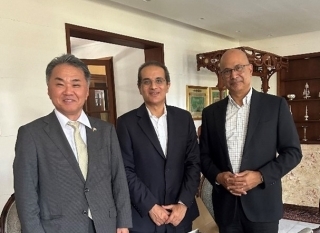
Anil C. Currimjee at a diplomatic meeting in Mauritius
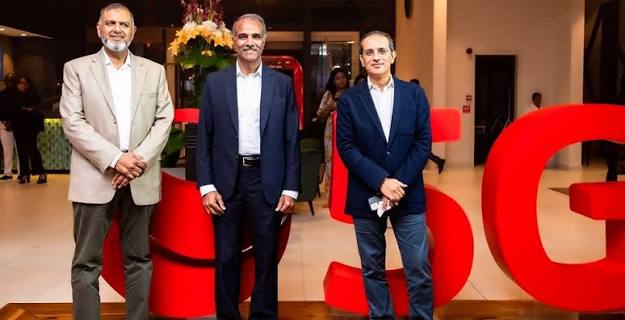
Anil C. Currimjee with colleagues at an ESG event in Mauritius
Bilateral and sustainability engagement — two threads that run through the group’s modern institutional life. The diplomatic relationships date from the founder’s Bombay office in 1907; the environmental commitments are more recent, structured through the Currimjee Foundation from 2009.

Source for the chronology throughout this page: Currimjee Group published corporate history, currimjee.com. National economic context is drawn from standard published accounts of Mauritian development and is identified as context where it appears.

The group today

Seven clusters, and the century that produced each one

The current structure is not a portfolio assembled by acquisition. Each cluster is the surviving descendant of an entry the group made when Mauritius itself opened that sector — which is why the dates below reach back so far.

01

Telecoms & Technology

Anchored by Emtel, with 5G coverage, Airbox fibre-to-the-antenna, the METISS submarine cable and the blink mobile banking service.

02

Real Estate

Quay 11, La Place, Currimjee Arcades and Le Nenuphar, managed largely through Compagnie Immobilière Limitée.

03

Tourism & Hospitality

The Le Chaland destination, operating since February 2026 as Constance Le Chaland under a management partnership.

04

Business Solutions & Commercial

Currimjee Informatics, Multi Contact and Screenage — IT services, outsourced customer relations and hospitality technology.

05

Energy

Gas distribution built on the Elf Antargaz partnership established in 1987, alongside the group’s TotalEnergies relationship.

06

Fast-Moving Consumer Goods

Quality Beverages Ltd and Soap and Allied Industries — bottling and household manufacturing dating to 1955 and the 1960s.

07

Financial Services

Insurance and financial services interests with roots in the Island General and Island Life businesses of the 1980s.

Currimjee Foundation

Established in 2009 to structure corporate social responsibility around education, health, environment and poverty alleviation, including coral reef rehabilitation at Le Chaland.

Stated purpose and values

What the enterprise says it is for

The group states its purpose as “together, building a better tomorrow through a value-driven culture”, and publishes five values: foresight — understanding customer and community needs in order to visualise better futures; integrity — being known for always doing what it says; responsibility — measuring success beyond profit through community and environmental impact; passion; and openness — an inclusive approach respecting diverse cultures and ideas.

Published values are easy to write and hard to audit. What makes this particular set worth reading is that three of the five are testable against the corporate record on this page. Foresight is a claim about capital allocation, and the 1955, 1989 and 2021 entries are the evidence for or against it. Responsibility is a claim about externalities, and the Currimjee Foundation and the reef rehabilitation programme are its visible instruments. Openness is a claim about who is admitted, and the 2024 listing and the appointment of a non-family Managing Director are the test.

The group’s own summary of its modern governance is direct: a transition from family-run operations to professional management, with structured succession, a non-family Managing Director, and the fourth generation holding executive positions within a formal structure rather than by right.

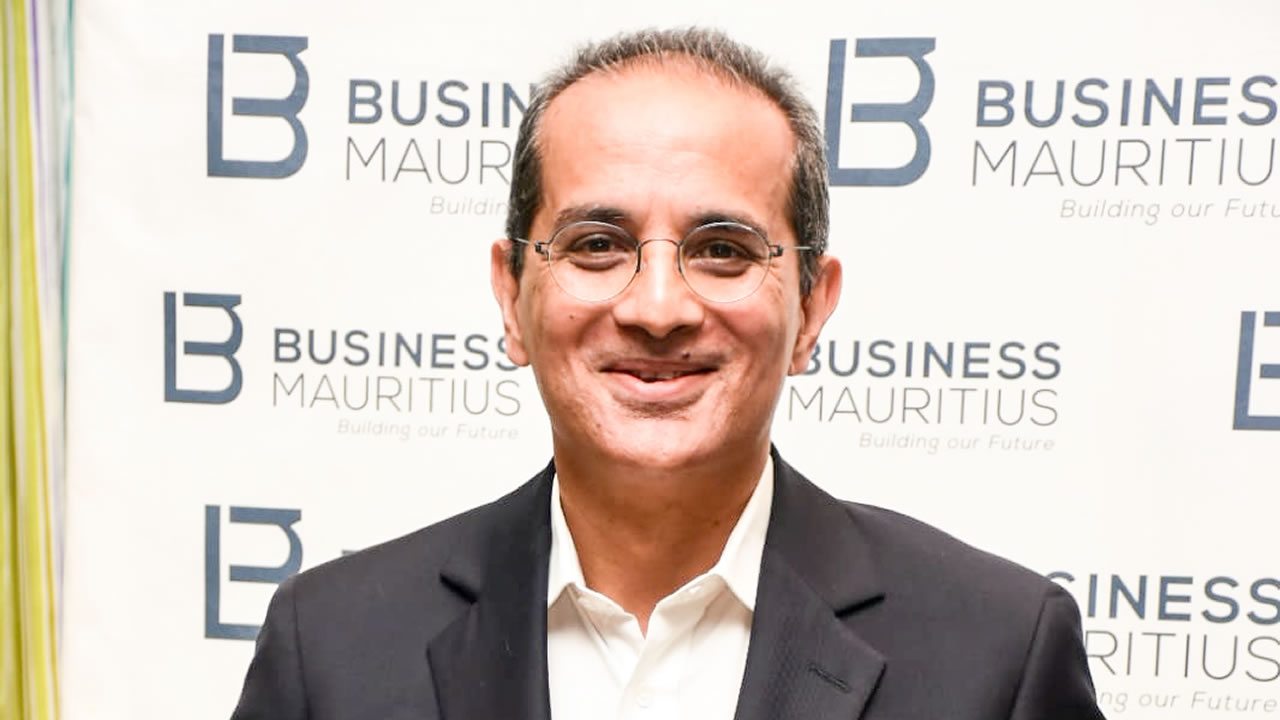
Anil C. Currimjee, Chairman of the Currimjee Group, at a Business Mauritius event
Anil C. Currimjee chairs both Currimjee Limited and Currimjee Jeewanjee & Co Ltd.

From history to strategy

The Business Perspective page takes the themes visible in this record — long-horizon capital, governance, openness, resilience — and sets them out as a working framework, with attribution clearly marked throughout.