1. Home
  2. Leadership Journey

Leadership journey

Seven chapters, one direction of travel

Careers inside family enterprises are often narrated as inheritance. Read against the dates, this one reads more like a sequence of institutional apprenticeships — a chamber of commerce, a consulate, a bilateral council, a listed company board, an employers’ federation — each one wider in scope than the last.

1982 — Williams College 2003 — MCCI presidency 2013 — Managing Director, CJ & Co 2023–25 — Business Mauritius presidency

There is a version of this story that would be easy to write and would be wrong: the heir who arrives, presides, and is credited with everything the enterprise achieves. The public record does not support it. What it shows instead is a leader who spent roughly two decades in institutional roles — often unpaid, frequently technical, usually collective — before taking operating command of the group, and who then used the chairmanship to complete a governance transition that reduces the family’s discretionary control rather than extending it.

The chapters below follow that sequence. Each is anchored to a documented date or appointment. Where an assessment is offered, it is presented as an assessment.

Chapter 01

1982 — 1988

Formation across two academic traditions

Anil C. Currimjee took his undergraduate degree at Williams College in 1982 and a Master of Business Administration at London Business School in 1988. The six-year interval between them is the sort of gap that usually indicates early working experience rather than continuous study.

The pairing is worth pausing on. Williams is a small American liberal-arts college with a strong economics tradition and no professional undergraduate track; London Business School in the late 1980s was one of the institutions actively importing American finance-and-strategy pedagogy into a European context. The first teaches you to argue from first principles across disciplines. The second teaches you to model, to compare, and to defend a position in front of people who will attack it.

Both registers are visible in the public interviews given three decades later — comparisons drawn to Singapore rather than to Mauritian precedent, arguments made about productivity and competitiveness rather than about entitlement, and a consistent preference for structural explanation over anecdote.

  • 1982Undergraduate degree, Williams College, Massachusetts
  • 1988MBA, London Business School
Chapter 02

2003 — 2004

The institutional apprenticeship begins

Anil C. Currimjee speaking at a press conference in Mauritius
Public commentary has been a constant of the institutional roles.

In 2003 he served as President of the Mauritius Chamber of Commerce and Industry. The MCCI, founded in 1850, is the oldest business institution in the country and its presidency has historically rotated annually among the heads of major Mauritian groups. The 2003 term placed him at the head of the chamber at a moment when the island’s two protected export pillars — sugar under the EU Sugar Protocol and textiles under the Multi Fibre Arrangement — were both approaching the end of their preferential regimes. The MFA quota system expired at the end of 2004; the EU sugar price reform followed shortly after. Mauritian business had to plan for a world without either.

In 2004 he took the chairmanship of the Joint Business Council linking Mauritius and India, a role he still holds, alongside the chairmanship of the Indo-Mauritius Chamber of Commerce & Industry. In the same period he began a consular appointment as Honorary Consul-General of Japan in Mauritius, which he would hold for more than fourteen years.

Three institutional roles in roughly two years, all of them outward-facing, all of them concerned with trade relationships rather than with the group’s own operations. For a small trading economy this is not a ceremonial portfolio; bilateral chambers and consulates are the substitute for the market access that scale would otherwise provide.

  • 2003President, Mauritius Chamber of Commerce and Industry
  • 2004Chairman, Joint Business Council Mauritius–India
  • 2004Director, Margarine Industries Ltd
  • To 2016Honorary Consul-General of Japan in Mauritius, held for more than fourteen years
Chapter 03

2013

Taking operating command of the group

In 2013 he succeeded Bashir Currimjee as Managing Director of Currimjee Jeewanjee & Co Ltd. In the same year he took the chairmanship of the Sanlam Africa Core Real Estate Fund Limited, a pan-African property investment vehicle — a mandate outside the family enterprise and outside Mauritius.

The group he inherited operationally was already diversified but not yet institutionally modern. Emtel had been in the market for over two decades; the hospitality and real estate ambitions at Le Chaland were still land holdings; the FMCG and energy businesses were established but privately held; governance still ran on the 1988 structure.

The following decade would change all three. The 2015 rebranding and the Airbox fibre-to-the-antenna launch; the sale of the Seychelles hotel asset in 2016 and the redirection of capital to Mauritius; the opening of Anantara Iko and Quay 11 in 2019; La Place, the Trampoline social-impact accelerator and the METISS submarine cable in 2021 — each is a step in converting land, licences and relationships into operating businesses with identifiable revenue lines.

  • 2013Managing Director, Currimjee Jeewanjee & Co Ltd
  • 2013Chairman, Sanlam Africa Core Real Estate Fund Limited
  • 2015Group rebranding; Emtel launches Airbox FTTA
  • 2016Seychelles hotel asset divested; capital redirected to Mauritius
Chapter 04

2016 — 2021

A board portfolio beyond the island

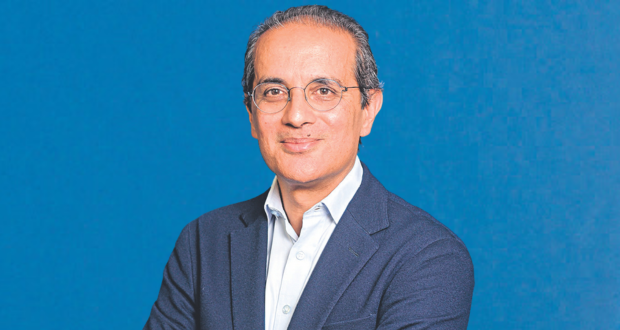
Executive portrait of Anil C. Currimjee
Board mandates in Mauritius, South Africa and across the region.

He joined the board of Emtel Limited in 2016 and, in 2019, the board of African Rainbow Capital Investments Limited — a Johannesburg-listed investment company. Earlier mandates on the boards of The Mauritius Commercial Bank Ltd, Fincorp Investments Ltd and The Mauritius Development Investment Trust Co. Ltd sit on the former-positions side of the register.

Taken together, the board portfolio describes an unusually complete map of the Mauritian capital system: a systemically important commercial bank, listed investment vehicles, a regional real estate fund, a South African investment holding company and a domestic telecommunications operator. Very few people in a market that size have sat in all of those rooms.

This period also delivered the group’s largest single infrastructure contribution to the country. The METISS submarine cable went live in 2021, adding an independent high-capacity route between Mauritius, Réunion, Madagascar and South Africa. For an island whose services exports depend entirely on international bandwidth, cable diversity is not a commercial nicety; it is the difference between a redundant system and a single point of national failure.

  • 2016Director, Emtel Limited
  • 2019Director, African Rainbow Capital Investments Limited
  • 2019Anantara Iko Mauritius Resort & Villas and Quay 11 open
  • 2021METISS submarine cable enters service; La Place opens
Chapter 05

2021 — 2023

Vice-presidency and the pandemic recovery

He served two years as Vice-President of Business Mauritius before his election as President. The vice-presidency covered the immediate post-pandemic period — a moment when the Mauritian economy was rebounding hard from a collapse in tourism, when public debt had risen sharply, and when the private sector’s relationship with government was being rebuilt around the Joint Public-Private Committee structure that his predecessor, Jean-Pierre Dalais, has described as the principal legacy of that presidency.

It is worth noting what the sequence implies about how this federation works. Business Mauritius does not parachute in a figurehead; it elevates a vice-president who has already sat through two years of technical work. The organisation’s continuity is structural, not personal — the same pattern repeated when Arnaud Lagesse, elected Vice-President alongside him in 2023, succeeded him as President in 2025.

  • 2021–2023Vice-President, Business Mauritius
  • 2022blink by Emtel launches mobile banking transactions
  • 2023Emtel begins 5G rollout, reaching 60% of localities by July
Chapter 06

2023 — 2025

The presidency of Business Mauritius

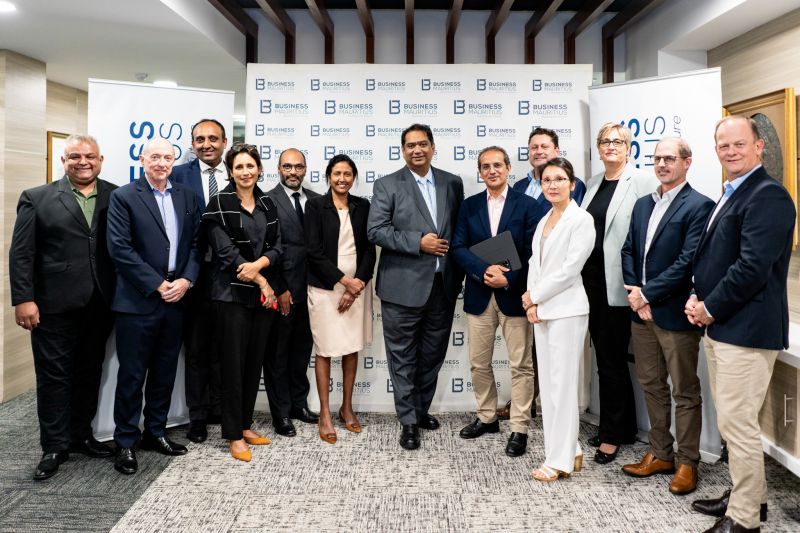
Anil C. Currimjee with the Business Mauritius leadership group at a Port Louis gathering
Business Mauritius federates employers across every sector of the Mauritian economy.

He was elected President of Business Mauritius on 28 September 2023, succeeding Jean-Pierre Dalais, with Arnaud Lagesse elected Vice-President. At the election he framed the mandate around adapting strategy to a world in structural change, and set out four axes aligned to the Joint Public-Private Committee agenda: climate change and the energy transition; social equity and inclusion for youth, women and persons with disabilities; the island’s connectivity; and financial services together with the attraction and retention of talent.

« Adapter nos stratégies à un monde en pleine mutation. »Anil Currimjee on taking the presidency, as published by Le Mauricien, 28 September 2023 — “Adapting our strategies to a world in full transformation.”

The two years that followed were not quiet ones. A general election and a change of government; a national salary adjustment introduced, in his account, outside the established legal framework and for electoral reasons, which Business Mauritius contested and which he later described as ultimately settled in the organisation’s favour; a pre-election episode of social-media restriction that, on his reading, left an impression of institutional weakness; and the assembly of “AI for All”, the country’s first national artificial intelligence plan, to which Business Mauritius contributed.

On the substance of his own agenda he claimed progress on three fronts and finished business on none. The port was elevated as a strategic economic lever. An alignment he described as unprecedented was built between the state, business, NGOs and development partners on climate resilience — a serious matter for a country facing measurable coastal erosion. On innovation he was explicit that the pace was insufficient, contrasting Mauritius with Singapore’s ability to adopt successive national plans within a few years, and calling for stronger digital connectivity and a better fintech environment.

He was equally direct about what he would have done with more time: bring the federation closer to small and medium enterprises, whose dynamism he identified as vital and whose distance from a large-employer federation is a structural weakness in most economies.

  • 28 Sep 2023Elected President of Business Mauritius
  • 2024Budget engagement; public opposition to the imposed salary adjustment
  • 2024–25Contribution to “AI for All”, the first national AI plan
  • 1 Oct 2025End-of-mandate interview published; Arnaud Lagesse succeeds as President
Chapter 07

2024 — present

Chairmanship through a structural reset

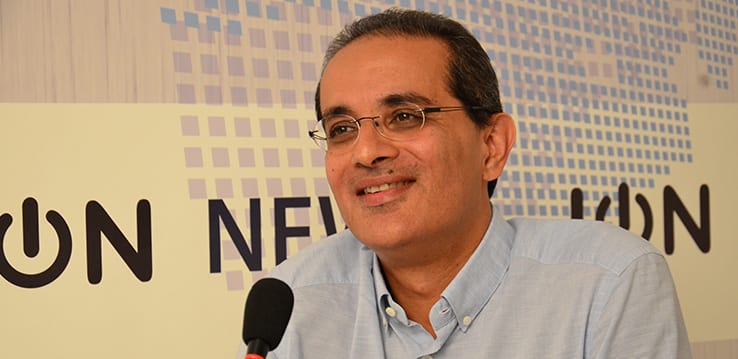
Anil C. Currimjee during a television interview in Mauritius
Explaining group and economic strategy in the Mauritian media.

The public mandate ran in parallel with the most consequential corporate period of his tenure. In July 2024, Emtel floated 25% of its shares on the Stock Exchange of Mauritius — taking the group’s flagship telecommunications asset, launched in 1989, onto the public market and subjecting it to continuous disclosure. In the same year the group implemented a strategic governance reorganisation, Currimjee Jeewanjee & Co Ltd acquired Quality Beverages Ltd, and Compagnie Immobilière Limitée completed the Quay 11 acquisition. A new group structure was established, with Iqbal Oozeer as Managing Director and Anil C. Currimjee as Chairman of both Currimjee Limited and Currimjee Jeewanjee & Co Ltd.

Two further moves complete the picture. In August 2025 the group ceased to hold a majority stake in MC Vision, retaining 25% — an exit from operational control of pay-television. In December 2025 it announced a management partnership with Constance Hotels for the Le Chaland property, which opened as Constance Le Chaland in February 2026. In November 2025 the group broke ground on the L’Avenir Distribution Centre; in February 2026 Quality Beverages inaugurated a new PET-3 production line.

Read as a portfolio, the direction is consistent: list what can be listed, partner where a specialist operator is better, exit where control adds nothing, and continue investing capital expenditure into the industrial and logistics base. That is a chairman’s agenda rather than a founder’s.

  • Jul 2024Emtel lists 25% on the Stock Exchange of Mauritius
  • 2024Group governance reorganisation; CJ acquires Quality Beverages Ltd
  • Aug 2025Majority stake in MC Vision released; 25% retained
  • Nov 2025L’Avenir Distribution Centre groundbreaking
  • Feb 2026Constance Le Chaland opens; QBL PET-3 line inaugurated

Reading the sequence

Four things the chronology actually shows

These are editorial observations drawn from the documented sequence above. They are our reading of the record, not statements attributed to Anil C. Currimjee.

01

Institutional roles preceded operating command

The MCCI presidency came in 2003; the Joint Business Council chairmanship in 2004; the consular appointment ran through the 2000s. The managing directorship of the group arrived in 2013. In most family enterprises the order is reversed — operating command first, institutional visibility as a consequence. Here, roughly a decade of collective and bilateral work came first.

02

Each mandate widened the constituency

A chamber of commerce answers to its members. A bilateral council answers to two national private sectors. A consulate answers to a foreign state. An employers’ federation answers to the whole private sector, and negotiates with a government that answers to the whole electorate. The constituency widened at every step, and the arguments had to become correspondingly less self-interested to survive scrutiny.

03

The chairmanship reduced family discretion

Listing a quarter of Emtel, appointing a non-family Managing Director, releasing majority control of MC Vision and handing hotel operations to Constance are all decisions that transfer authority away from the owning family and towards markets, professional managers and specialist operators. A leader optimising for personal control would have chosen differently at each of those four junctures.

04

The public positions were costly ones

Arguing that wage increases must be paired with productivity, and that the country needs to import skills it does not yet produce, are not positions that win easy public approval in any economy. That they were stated repeatedly and on the record is itself a data point about how the role was understood — as advocacy for a policy position rather than management of a reputation.

The enterprise behind the career

The Currimjee Legacy page traces the business itself — from a trading ledger opened in Port Louis in 1890 to a seven-cluster group with a listed telecommunications operator.